In Japan a doll is never quite “just a toy.” The word ningyō (人形) literally means “human form,” and dolls run through Japanese life as festival centrepieces, protective charms, fine art and cherished heirlooms. From the limbless wooden kokeshi of the northern hot springs to the ornate imperial court of the Hina festival, Japanese dolls are among the most refined and meaningful in the world.
Kokeshi — the wooden children of the north
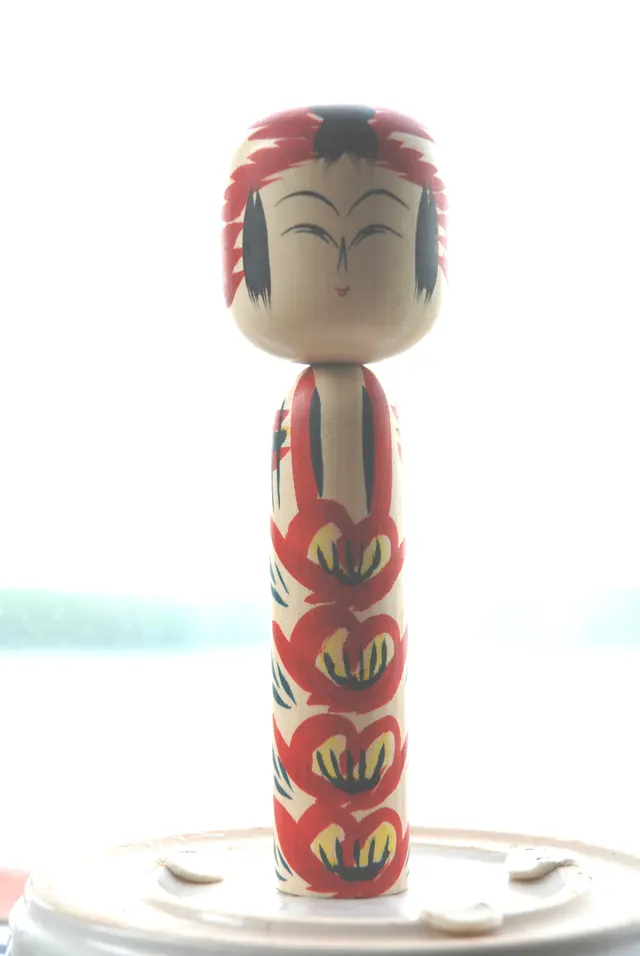
The kokeshi is a simple wooden figure with a round head and a plain cylindrical body — no arms, no legs — hand-turned on a lathe and painted with floral and geometric patterns. They have been made for around a century and a half in the Tōhoku region of northern Honshū, originally by woodworkers (kijiya) in hot-spring (onsen) towns, both as toys for farmers’ children and as souvenirs for visitors taking the waters.
What makes kokeshi endlessly collectable is their regional variety: each district has its own recognisable “strain” — distinct head shapes, body proportions and painted motifs — so a practised eye can name the town a doll came from. Traditional (dentō) kokeshi follow these inherited styles, while creative (sōsaku) kokeshi let modern makers invent freely.
Hina dolls & the Girls’ Festival
Every 3 March, Japanese families with daughters celebrate Hinamatsuri (Doll’s Day, or the Girls’ Festival) by setting out a tiered display of Hina ningyō. A full set is a miniature imperial court: the Emperor and Empress on the top step, then three court ladies, five musicians, ministers and guards arranged by rank down the platform. The display expresses a wish for the daughters’ health and happiness.
The custom descends from a much older, humbler rite called nagashi-bina, in which simple paper dolls were floated away down a river to carry off illness and misfortune — a doll as a vessel for what a family wished to release.
Daruma — the doll that will not stay down
The round, red Daruma doll represents Bodhidharma, the monk credited with founding Zen Buddhism. Weighted at the base, it always rocks back upright when pushed — embodying the proverb nanakorobi yaoki, “fall down seven times, stand up eight.” Daruma are sold with blank white eyes: you paint in one eye when you set a goal or make a wish, and the second only once it is achieved.
Kimekomi, gofun & Hakata: the craft
Kimekomi is a distinctive way of “dressing” a wooden doll without sewing: grooves are carved into the body and the edges of patterned cloth are tucked into them, so the costume appears moulded to the figure. Faces and hands are finished with gofun, a lustrous white made from ground oyster shell and glue, layered over a paulownia-wood base to give that luminous porcelain-like skin.
From Fukuoka in the south come Hakata dolls — unglazed white-clay figures, moulded, biscuit-fired and then delicately hand-painted, prized for their lifelike movement and fine detail.
Frequently asked questions
What is a kokeshi doll?
A kokeshi is a traditional Japanese wooden doll with a round head and a plain cylindrical body — no arms or legs — hand-turned on a lathe and painted with regional floral patterns. They originated as toys and hot-spring souvenirs in the Tōhoku region of northern Japan about 150 years ago.
What do Daruma dolls mean?
The round red Daruma doll represents Bodhidharma, the founder of Zen Buddhism, and embodies perseverance — “fall down seven times, stand up eight.” You paint in one blank eye when you set a goal and the second only when it is achieved.
What is Hinamatsuri?
Hinamatsuri, or Doll’s Day, is a Japanese festival held on 3 March. Families with daughters display a tiered set of Hina dolls representing the imperial court, to wish the girls health and happiness.
Sources & further reading
Written in our own words from the references above and other reputable sources. Cultural traditions vary locally and scholarship evolves; corrections are welcome via our contact page.