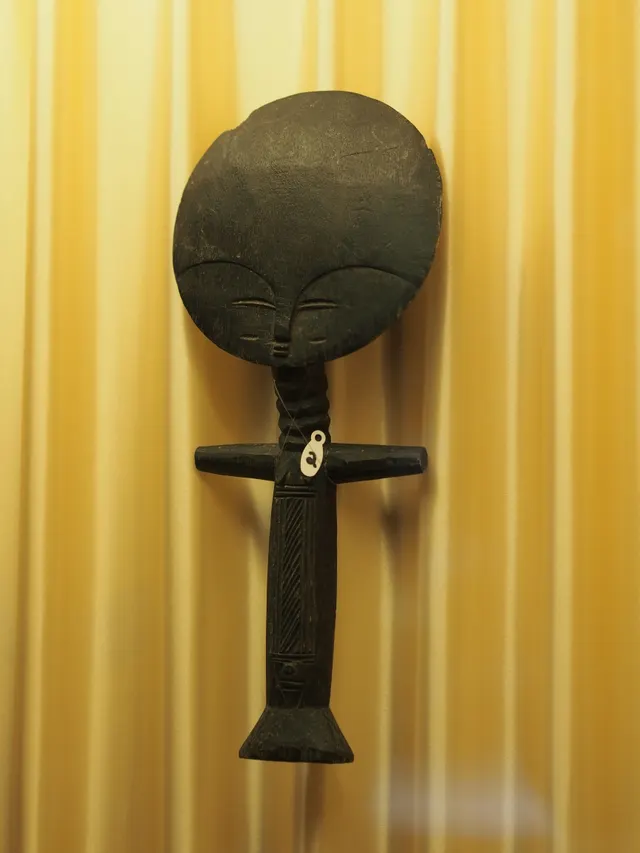
In much of Africa the doll is less a toy than a carrier of hope and identity — a figure for fertility, for a girl’s coming-of-age, or for remembering. The most celebrated of all is the akua’ba of Ghana, whose serene flattened face is instantly recognisable the world over.
Akua’ba — “Akua’s child”
The akua’ba is a wooden ritual figure of the Akan peoples of Ghana (especially associated with the Fante and Ashanti). A woman hoping to conceive would have one carved, then care for it — feeding it, dressing it, carrying it on her back — as if it were a living child, to encourage a healthy pregnancy and safe delivery.
Its name means “Akua’s child,” after a legend of a woman named Akua who, though childless, tended a carved wooden doll until she at last became a mother.
Reading the form
The classic akua’ba has a high, flattened disc-shaped head, a small ringed neck and simple outstretched arms. The broad forehead reflects an Akan ideal of beauty and intelligence, and the rings on the neck signify health and prosperity. The wood is often darkened and polished smooth with long handling.
Beaded dolls of the south
Elsewhere on the continent, dolls carry their meaning in colour and beadwork. The Ndebele and Zulu peoples of southern Africa make richly beaded dolls given to girls at initiation, their shapes and colours encoding social status and stages of life. Among the Namji (Cameroon) and other groups, beaded fertility dolls are carried and cherished in much the same spirit as the akua’ba.
Frequently asked questions
What does an akua’ba doll mean?
The akua’ba is an Akan wooden fertility figure from Ghana, carried by women hoping to conceive and ensure a safe birth. Its name means “Akua’s child,” after a legend of a woman who cared for a carved doll until she became a mother.
Why does the akua’ba have a flat, disc-shaped head?
The broad, high forehead reflects an Akan ideal of beauty and intelligence, while the rings on the neck signify health and prosperity.
Sources & further reading
Written in our own words from the references above and other reputable sources. Cultural traditions vary locally and scholarship evolves; corrections are welcome via our contact page.